
Last updated: 10 September 2026
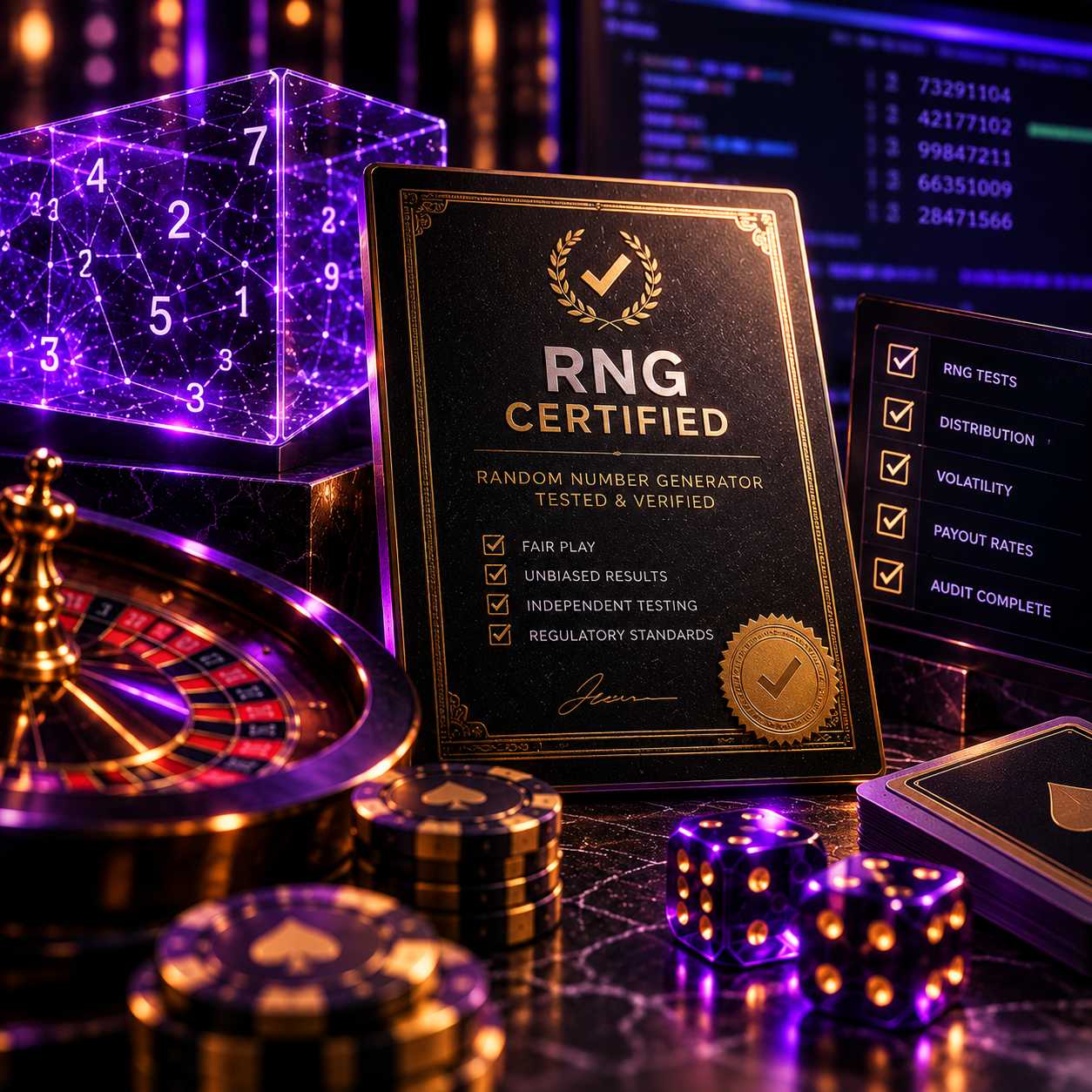
Quick Answer: RNG certification is an independent test house’s signed verdict that a game’s random number generator produces statistically unpredictable, unbiased results. An accredited lab runs the generator through statistical test suites and issues a report you can read. Power.Win publishes one for its RNG; it covers number generation, not operator conduct, and not any single spin.
Nearly every casino site tells you its games are certified. Few say what was tested, who tested it, or what the certificate deliberately leaves out. Miss those three answers and “certified” is a word doing no work at all. Certification and provably fair verification are different claims doing different jobs, and only one of them puts the checking in your hands.
What does an RNG certificate actually attest to?
An RNG certificate confirms that one named generator, submitted by one named company and tested on one date, passed a defined battery of randomness tests. That’s all it says.
Who ran the test matters as much as the verdict. An accreditation body checks the lab against ISO/IEC 17025, and the lab checks the generator. That two-step chain is what makes a test house independent: it has no stake in the result, and it answers to someone else for the way it works.
What does a test house actually measure?
Four properties, and each one has a specific failure mode.
| Property tested | What it means | What failure looks like |
|---|---|---|
| Uniformity | Every possible output appears about as often as every other | One card, pocket or multiplier band turns up more than its share |
| Independence | Each result is unrelated to the ones before it | Runs, streaks or repeats appear more often than chance allows |
| Unpredictability | Knowing past outputs does not narrow down the next one | Output becomes forecastable from a captured sequence |
| Correct mapping | Raw numbers are scaled to game outcomes without distortion | The generator is fine, but the game skews it at the last step |
The actual batteries are publicly available. NIST Special Publication 800-22 specifies fifteen statistical tests for random number generators used in cryptographic applications, and the gaming-specific requirements sit in the GLI standards series. The methods used are not secret.
What does an RNG certificate not cover?
This is the part that gets skipped, and it matters more than the verdict does.
- It is not a licence. Certification is a technical test of a product. Licensing is an authority’s permission to operate. Different bodies, different questions.
- It says nothing about the operator’s conduct. Payout processing, account handling, bonus terms and support are all outside the scope of a generator test.
- It cannot confirm your individual result. A certificate covers the generator in aggregate. It does not reach down to the specific spin you played on Tuesday.
- It has a date and a version. A report describes the build that was submitted, at that time.
- It rests on what was supplied. A test report is based on the data and code the client provided to the lab.
An operator that explains these restrictions gives you much more usable information than one that displays a badge and does nothing else.
How is RNG certification different from provably fair?
Certification is a verdict someone else reached about the generator as a whole. Provably fair is a cryptographic commitment that lets you re-check one specific bet you placed, yourself, at any time. They are not interchangeable, and the second is the stronger claim on a single result.
| Independent certification | Provably fair verification | |
|---|---|---|
| Who checks | An accredited test house | You |
| What is checked | The generator, in aggregate | One bet you personally placed |
| When | Once, on a dated build | Any time, on any round |
| What you can do | Read the report | Reproduce the result yourself |
| What it cannot do | Confirm your individual result | Speak for games outside the scheme |
Which Power.Win games are provably fair, and which are certified?
The split is real and worth knowing before you play.
PWR Originals — Crash, Plinko, Mines, Dice, Blackjack and Roulette — are provably fair. Before a round, the server seed is hashed with SHA-256 and the hash is shown to you. Your client seed is generated on your side and you can change it. A nonce starts at 0 and increments with every bet. Rotate your seeds and the previous server seed is revealed, so you can hash it and confirm it matches the commitment shown earlier. The mechanics are set out on the provably fair page, and the step-by-step walkthrough lives in Provably Fair Explained: How to Verify Results.
Third-party slots are independently certified instead. Power.Win describes them as coming from certified third party providers, and that phrase is carrying the weight: the certificate belongs to the provider’s product, not to the round you just played. Live dealer tables sit outside this question altogether, because the wheel or the shoe is physical and there is no number generation to test. On either kind of game you can’t run a per-spin check yourself, because no seed and nonce interface is exposed to you.
So when a site tells you its games are fair, it is worth asking which of the two claims it means. The answer changes what you can do about it: on one you can re-run a single round yourself, and on the other you are reading a verdict someone else reached.
What does Power.Win publish on its RNG certificate?
The RNG certification page publishes the report header rather than a badge, so the fields can be read directly:
| Field | Published value |
|---|---|
| Certifying body mark | RiskCherry |
| Report ID | CHERRY.222626.MGA.RO |
| Customer | 3-102-968317 SRL (Power.Win) |
| Product name | Power.Win RNG |
| Test house | Lean Lab Company Limited – Malta |
| Compliance verdict | Compliant |
The operator publishes the certificate itself as a one-page PDF carrying those fields and the lab’s disclaimer, not the underlying test data. Separately, Power.Win is operated by 3-102-968317 SRL of Costa Rica and licensed by the Tobique Gaming Commission under licence 0000209. The certificate is a lab’s verdict on a generator; the licence is a regulator’s permission to run the platform.
Can RNG be manipulated in games?
On a provably fair round, the operator can’t move the outcome once it is locked. You see the hash of the server seed before you bet, and nothing behind that hash can change afterwards. If the seed revealed later doesn’t hash back to the commitment you were shown, you know straight away.
On a certified game the protection is structural instead. An accredited lab tested the generator, the operator holds a licence it can lose, and the build that was tested is meant to be the build you’re playing. That is a real chain of responsibility, but it is one you read rather than one you check: the report tells you a lab signed the generator off, and it says nothing at all about the round you just played.
Can you beat a random number generator?
No, and the reason is the two properties that matter most here. Independence means earlier results carry no weight in what comes next. Unpredictability means that watching a run of outputs doesn’t narrow down the one that follows it. A generator you could read your way past would fail certification, because resisting exactly that is written into the specification.
The math behind it is easy enough to do in your head. Take single-zero roulette: 37 pockets, and a straight-up bet on one number pays 35 to 1 when the true odds are 36 to 1. That gap of one pocket between the payout and the true odds is the house edge — 1/37, or 2.70% — and it is the same on every spin, whatever the wheel has just done. Wager $1 a spin for 1,000 spins and you have turned over $1,000 at an expected cost of $27. Ten reds in a row don’t change the next spin either: red is still 18 pockets in 37, or 48.65%. The margin sits in the pay table, not in the pattern. There is more on this in RTP, House Edge, and Variance.
What is an example of an RNG game?
An RNG game is one whose outcome comes from a random number generator rather than a real-world event. Online slots, digital roulette, video poker, dice, crash, plinko and mines are all RNG games. A live dealer table is not — the wheel or the shoe is physical, and it is streamed to you.
That distinction is why two different fairness claims exist in the first place. A physical wheel can’t be hashed and committed to before it turns, so a live table rests on studio procedure rather than on anything you could re-run afterwards. A digital outcome can be committed to in advance — but only where the operator hands you the seeds and the nonce, which on Power.Win means the PWR Originals. Third-party slots run on generators too, and without that interface the certificate is all you get.
How do you check an operator’s RNG certification?
Five checks, and none of them takes more than a minute.
- Is there a certificate page at all? If there’s no page behind the claim, it’s just a sentence.
- Does it name the test house? A verdict is only worth what the name attached to it is worth.
- Is there a report ID and a product name? Those two fields are what make a report identifiable rather than decorative.
- Does the customer on the report match the licensed entity? The company tested should be the company licensed. Power.Win publishes 3-102-968317 SRL on both.
- For per-round checking, is there a seed interface? If you can see a hashed server seed, set your own client seed and watch a nonce increment, you can verify results without asking anyone’s permission.
Frequently Asked Questions
Does a certificate still cover a game after it is updated?
Only for the build it names. A report describes the version submitted on the date it was issued, so a later build sits outside it until that one is tested too. This is why the report ID and the product name are the fields worth reading: they tell you which thing was tested, and Power.Win publishes both in its report header.
Should the company on the certificate match the licensed operator?
Yes, and it is the check most people skip. The customer named on the report should be the same entity that holds the operator’s licence, and Power.Win publishes 3-102-968317 SRL in both places. A certificate issued to some other company tells you nothing about the operator you are actually playing at.
Can you give me an example of an RNG game?
Online games driven by a random number generator include slots, online roulette, video poker, dice, crash, plinko and mines. Live dealer games do not use one, because the event happens physically and is streamed to you.
Is a certified game the same as a provably fair game?
No. They are two different claims. Certification is an accredited lab’s conclusion about the generator as a whole, reached once on a dated build. Provably fair verification lets you reproduce one specific result yourself, whenever you want, from the seeds and the nonce.
Does an RNG certificate mean the operator is licensed?
No. A certificate is a technical test of a product; a licence is an authority’s permission to run the activity. Power.Win publishes both, separately: a Lean Lab report for the generator, and Tobique Gaming Commission licence 0000209 for the platform.
Sources (Citations)
- NIST Special Publication 800-22 Rev. 1a — the statistical test suite specification for random number generators
- GLI Standards — published testing standards for gaming devices and online systems
- International Laboratory Accreditation Cooperation — how testing laboratories are themselves accredited
- Power.Win RNG certification report (PDF) — issued by Lean Lab Company Limited, Malta
Take the Lead, Gamble Responsibly
Understanding how a result is produced is worth knowing. It doesn’t change the margin, and it isn’t a reason to play longer than you meant to. Decide what a session is worth to you before you start, and set your limits using the deposit limits, wagering limits, self-exclusion and Track your Activity tools on the responsible gambling page. If you feel that it is no longer enjoyable, stop playing and use the support options listed there.
By the Power.Win Editorial Team