
Last updated: 10 September 2026
Quick Answer: Only if the case opening site hashes its server seed before you open and reveals that seed afterwards. That two-step commitment is what provably fair means; a fairness badge on its own proves nothing. Power.Win publishes the SHA-256 server seed hash up front and reveals the seed when you rotate seeds.
The animation slows, an outcome lands, and you have no way of knowing whether that result was decided before you clicked or after. A badge in the footer will not tell you. Neither will a page of cryptography talk. Both are claims a site makes about itself, and neither one is something you can check.
The real test takes about two minutes. Either a site publishes the server seed hash before the round and reveals the seed afterwards, or it fails the test. Everything below is that test, run end to end with real values you can reproduce on your own machine.
What does provably fair actually prove on a case opening site?
Provably fair proves one thing: the outcome was fixed before you opened, and nobody changed it afterwards. That’s the whole claim, and it holds because the site has to lock the result in advance and then hand you the evidence.
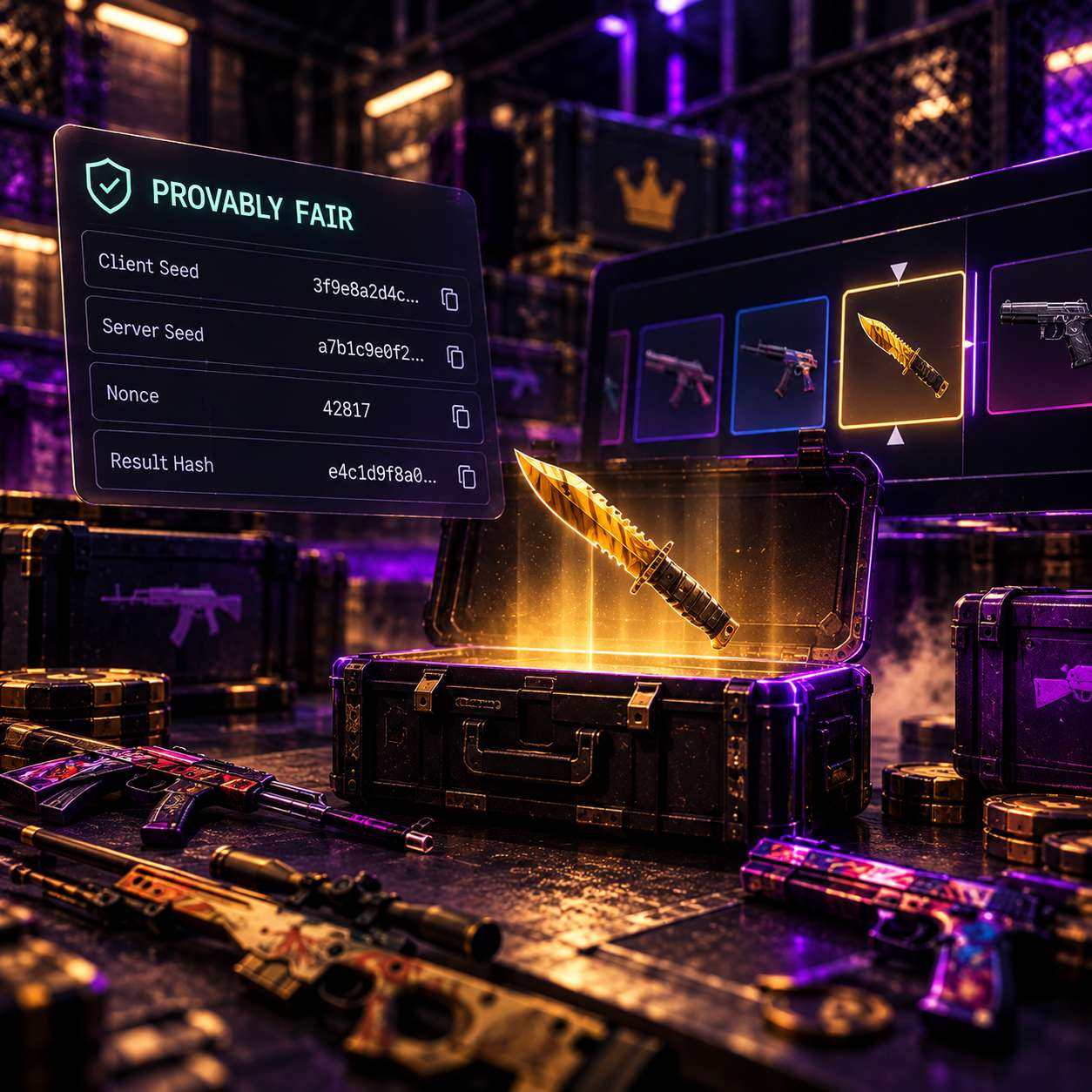
This mechanism is known as a commitment scheme. The outcome depends on three inputs, and none of them can be changed once the round is committed.
| Input | Who controls it | How it is locked before the round |
|---|---|---|
| Server seed | The site | Hashed with SHA-256 and shown to you before you open. The hash cannot be reversed, so the seed stays secret, but it also cannot be swapped later without breaking the match |
| Client seed | You | Generated on your device, and you can overwrite it with any string you like |
| Nonce | Automatic | A counter that rises by 1 with every bet, so the same pair of seeds never produces the same result twice |
Power.Win’s provably fair page spells out how that lock works in practice: the server seed is hashed when it is created, only the hash is used during play, and the seed is released when you rotate. SHA-256 is not something the operator defines. It is a published federal standard, FIPS 180-4. The general mechanism is covered in Provably Fair Explained; this page applies it to case opening.
“Provably fair” and “certified” sound interchangeable, and plenty of sites use them that way. They are not the same claim. Provably fair is a per-round proof you run yourself. Certification is an independent laboratory testing the random number generator itself, and Power.Win publishes its RNG certificate for that. One covers the round you just opened. The other covers the generator sitting behind every round. So a site that uses one of those words to mean the other is telling you something untrue.
How do you verify a case opening result yourself?
If you recompute the hash and it matches the site’s exactly, that round wasn’t tampered with. Here’s the full sequence, with real values you can paste straight into a terminal.
Step 1: copy the commitment before you open. The site shows a server seed hash. In this worked round it is:
9968344975900289ea47a7cf934956f8a8b30bf920fb843493b34137a9ef38d7Step 2: set your client seed. Overwrite the one you were given so the input is provably yours. Here it is power-win-demo-7. This example uses 0 as the first nonce.
Step 3: open the case, then rotate your seeds. Rotation is what forces the reveal. The site hands back the server seed it had committed to:
8f1c3a7d9e2b4c6a1d5f0e83b7a2c4d6Step 4: check the commitment matches. Hash the revealed seed and compare it to what you copied in step 1:
echo -n "8f1c3a7d9e2b4c6a1d5f0e83b7a2c4d6" | shasum -a 256
9968344975900289ea47a7cf934956f8a8b30bf920fb843493b34137a9ef38d7
Identical. The seed revealed after the round is the one the site committed to before it. That single comparison is what would expose tampering, and it’s the step most people skip.
Step 5: reproduce the outcome. Combine the three inputs and hash the result. This round joins them with colons, in the order server seed, client seed, nonce:
echo -n "8f1c3a7d9e2b4c6a1d5f0e83b7a2c4d6:power-win-demo-7:0" | shasum -a 256
ed9ec274fce063eb0ab5b6319f49b56cd3d5595a1aa32002aa5794db5d57c477
Step 6: map the hash to the drop table. Take the first eight hex characters, ed9ec274, convert to decimal (3,986,604,660), then take the last four digits and divide by 100. That gives 46.60.
Check 46.60 against the case’s published drop table. In the example table below it lands in the common tier, which is where the overwhelming majority of rolls land on any case.
| Tier | Chance | Range on the roll |
|---|---|---|
| Common | 80.00% | 0.00 – 79.99 |
| Uncommon | 16.00% | 80.00 – 95.99 |
| Rare | 3.00% | 96.00 – 98.99 |
| Very rare | 0.80% | 99.00 – 99.79 |
| Top tier | 0.20% | 99.80 – 99.99 |
One caveat on the calculation. The exact way the three inputs are joined, and the way the hash is scaled into a roll, differs between operators. Treat the sequence above as the shape of the check rather than a universal formula, and follow whatever input order and scaling the site you are on actually describes. If it describes neither, that tells you something too.
What provably fair does not prove
This is where the badge oversells itself, and knowing the limits is what makes the proof useful.
- It does not prove the odds are good. A round can be perfectly verifiable and still sit on a drop table that weights nearly everything into the lowest tier. The proof confirms the draw was honest, not that the draw was generous.
- It does not prove the table you were shown is the table that was used. Verification confirms the result of a draw, not the set of odds that draw came from. Those odds only become checkable when a site publishes per-case percentages in the first place, and against a site that publishes none, a verified result has nothing to be measured against.
- It does not certify the operator. That’s what independent RNG testing and a named licence are for. Power.Win operates under the Tobique Gaming Commission, licence 0000209, held by 3-102-968317 SRL of Costa Rica.
- It does not make an outcome predictable. The commitment fixes the result before you open; it gives you no information about what that result will be.
- It does not put an item in your Steam inventory. Nothing material changes hands. Cases on Power.Win settle as a cash equivalent credited to your account balance, and what you hold in Steam is governed by the Steam Subscriber Agreement, which a third-party site does not touch.
Is opening a case gambling?
Opening a case is a wager, not a game of skill. Nothing you do between clicking and the result changes your odds, so the drop table and the proof are the only two things worth examining.
Valve publishes the per-case odds inside the game client, and announces changes to how those cases work on the official Counter-Strike blog. Opening a case on a third-party site is the same transaction in a different interface: you pay, a fixed set of odds decides, an outcome lands. One difference matters. A provably fair site lets you verify the individual round you just opened. The game client doesn’t.
Treat what you spend as spending, not as an investment. Responsible gambling tools matter most in a format like this, where rounds resolve in seconds and the animation is built to be repeated.
Are CS2 cases worth opening?
Open enough cases and you get back less than you put in. That isn’t a flaw in a particular site; it’s the arithmetic of a drop table that has to pay for its rare tiers out of its common ones.
Take the example table above. A top tier that shows up 0.20% of the time is roughly one open in 500, and the other 499 are what pay for it. That is how the mechanism works wherever it is used: many small outcomes fund a few large ones, and the margin sits across the whole distribution.
So the question worth asking isn’t whether a case pays. It’s whether you can see the drop table and the expected return before you open, and check the result against them afterwards. If a site publishes both, check them. If it publishes neither, you are trusting whoever runs the site.
What separates a verifiable case site from one that only says provably fair?
Five checks. Each one is either visible on the site or it is not. This is a checklist, not a ranking, and you can run it against any operator in the sector in about two minutes, without depositing anything.
| Check | What has to be visible | Why it decides the question |
|---|---|---|
| Server seed hash shown before the round | The hash, on screen, prior to your open | Without a prior commitment there is nothing to verify against |
| Seed reveal on rotation | The original server seed, handed back to you | An unrevealed seed makes the commitment unfalsifiable |
| Editable client seed | A field you can type your own string into | If the site controls both seeds, your entropy is theoretical |
| Published per-case odds | A percentage against every outcome, summing to 100 | A verified result is meaningless against an unpublished table |
| The method written out | The hash function and the input order | You cannot reproduce a calculation nobody has described |
On Power.Win, the first three of those are what its provably fair page documents: the server seed hash is shown before the round, the seed comes back when you rotate, and the client seed is yours to overwrite. The in-product verifier reproduces any round. The same commitment covers case battles, where several people open the same cases against one another and every round in the battle carries its own verifiable result. You can see the format and the current cases on the cases page.
Read more: Best CS2 Case Opening Sites 2026 covers which names surface in this category and the checks worth running on each.
Frequently Asked Questions
Can a case opening site fake a provably fair result?
Not without breaking the hash match. If the revealed server seed hashes to anything other than the hash you were shown before your round, then the seed was exchanged and the proof must fail. That comparison is the entire defense, and it takes one command to run.
What is a server seed and a client seed?
The server seed is the site’s input. It is hashed before the round and only the hash is shown to you, so the seed cannot be swapped later. The client seed is your input, created on your device, and you can overwrite it with any string you like. Hash those two together with the nonce, the counter that moves on with every bet, and you get the result for that round.
Does provably fair mean the odds are good?
No. It proves the round was settled before you opened and never changed afterwards. How generous a case is depends on its drop table, and that is a separate thing to check. If a site never publishes its table, a verified round still leaves you knowing nothing about the odds you were up against.
Do you get a real CS2 skin from a case site?
No. Nothing physical or tradable changes hands. On Power.Win, cases and mystery boxes settle as a cash equivalent credited to your account balance, and your Steam inventory is untouched. If you are not sure how a particular site settles what you open, its own terms are where that is written down.
Is opening a case inside CS2 the same as opening one on a case site?
No. Valve publishes per-case odds in the game client, but gives you no way to verify an individual round. A provably fair site publishes a seed commitment before the round and reveals the seed after it, so you can confirm the specific outcome you got instead of taking the published odds on trust.
Sources (Citations)
- Power.Win — Provably Fair: server seed hashing with SHA-256, client seed override, nonce increments on every bet, seed reveal on rotation, independent verification.
- Power.Win — RNG Certificate: independent random number generator certification, held separately from provably fair mechanics.
- NIST FIPS 180-4, Secure Hash Standard: the published specification for SHA-256.
- Steam Subscriber Agreement: the terms governing Steam inventory items.
- Counter-Strike blog: Valve’s official channel for changes to how in-game cases work.
Take the Lead, Gamble Responsibly
Verification proves a round was honest. It says nothing about how much you should be spending, and that second question is the one that decides how this actually goes for you. A case takes seconds from click to outcome, so limits matter more in this format than in a slower one, and a limit only does its job if you set it before a session rather than partway through. Power.Win’s responsible gambling tools cover deposit limits, wagering limits, self-exclusion and Track your Activity, and link to support resources.
By the Power.Win Editorial Team.