
Last updated: 15 September 2026
Quick Answer: Crypto casino withdrawals on Power.Win are “usually instant or take up to 24 hours” without pending verifications, per its terms, then the network confirms. The slower clock is approval: a large amount, an address change or a pending KYC step sends a request to manual review, which can take a few hours. After release, your coin’s network sets the pace.
You’ve made a withdrawal request, and the money has already left your balance, yet it still hasn’t reached your wallet. Two separate clocks are running: the casino’s approval and the blockchain’s confirmation. Power.Win payments are crypto only, run through Coinspaid / Alphapo, and carry no house fee. The network fee is the only fee you pay, and you see it before you confirm.
How long do crypto casino withdrawals take?
On Power.Win, the casino side of crypto casino withdrawals is usually immediate, and after release the network sets the pace: minutes on fast networks, or roughly an hour if your wallet waits for 6 Bitcoin confirmations. When a request is held, the approval step is what stretches the wait. Power.Win’s deposit and withdrawal guide says withdrawals “are processed immediately in the vast majority of cases” and “usually land on your wallet within a few minutes.”
What do Power.Win’s FAQ and terms add?
The FAQ adds the review case and the terms give an upper figure. Power.Win’s payments FAQ states that manual review “can take a few hours for large amounts or pending KYC,” and its Terms and Conditions state:
“Withdrawal requests are processed as soon as reasonably practicable and are usually instant or take up to 24 hours if there are no pending verifications that need to be completed. Once released by the Company, completion of the transaction depends on the relevant blockchain network and is outside the Company’s control.” (Power.Win Terms and Conditions)
How do the docs and the terms fit together?
The documentation outlines the standard scenario, while the terms give an upper figure, and both place an open verification outside the fast path. The terms’ figure applies only “if there are no pending verifications,” which means a KYC step you haven’t finished sits outside it. Once the transaction is released, completion depends on the blockchain network, which the terms say is “outside the Company’s control.”
Read More: The Power.Win casino lobby
Which clock are you waiting on: the casino’s approval or the blockchain?
You’re waiting on the casino’s approval first and the blockchain second, and only the first is in the casino’s hands. Approval covers the risk flags and any open verification step. Once the transaction is broadcast, the process goes to the network, and no support ticket can make a block arrive sooner.
Read More: Fastest Withdrawal Crypto Casinos 2026
What happens between your request and your wallet?
A Power.Win payout involves four distinct steps, and the TXID tells you which clock you’re on: without a TXID, the request is still waiting on approval, while a TXID means the payment has been sent to the network.
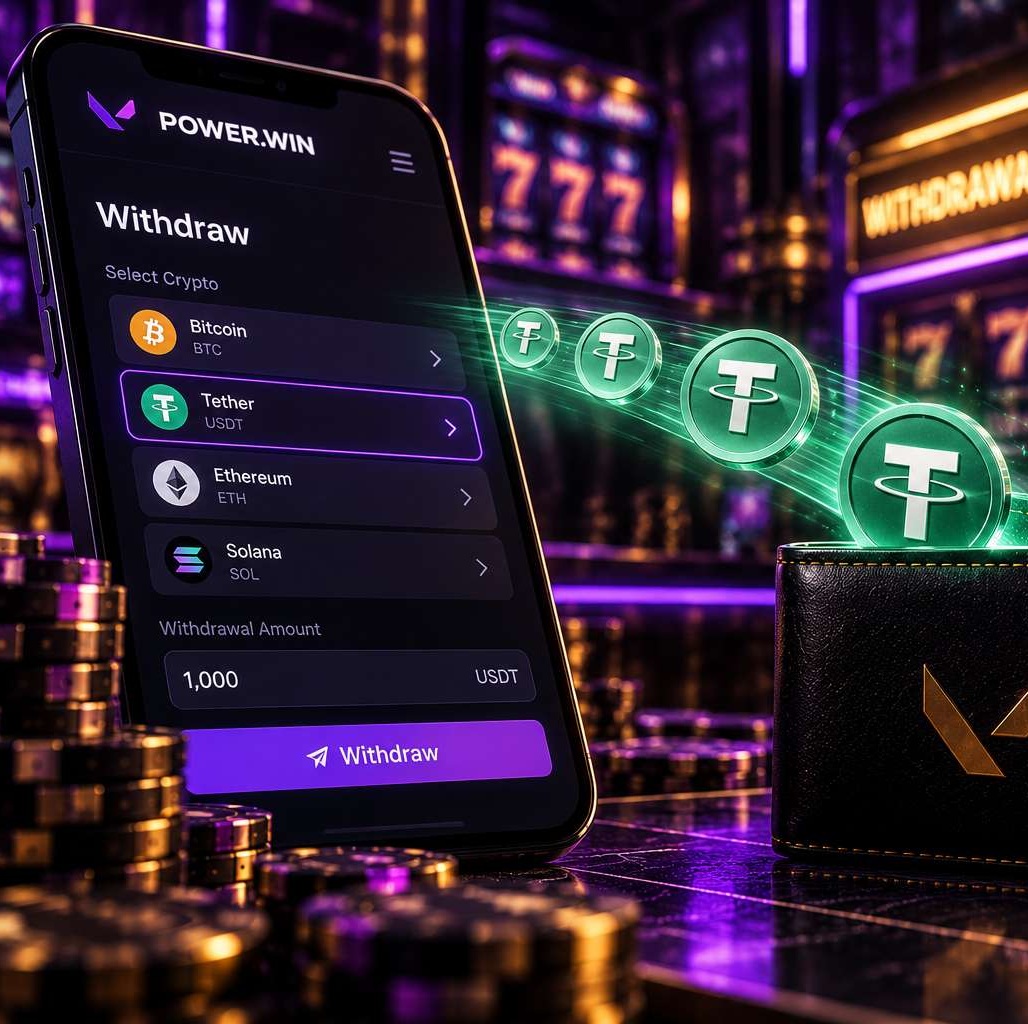
- Your request. In Wallet, you open Withdraw, select the currency, enter your wallet address, choose the network and confirm. The network fee is shown before you do.
- The casino’s approval. Most requests clear here straight away. A risk flag sends yours to a manual review instead.
- Broadcast. The transaction goes out through Power.Win’s payment rails, Coinspaid / Alphapo, and gets a TXID, the transaction hash you can look up on a block explorer.
- Confirmation. The network includes the transaction in a block. Your receiving wallet decides how many confirmations it wants before it shows the funds as settled.
How long does each coin’s network take to confirm?
Each network’s timing for confirmation is set by its protocol, not by the casino. Bitcoin adds a block about every 10 minutes on average, Ethereum runs a slot every 12 seconds, and Solana targets roughly 400ms per slot. Of the three networks, Bitcoin is the slowest.
| Coins offered | Network | Block or slot time | Source |
|---|---|---|---|
| BTC | Bitcoin (on-chain only) | About every 10 minutes on average; block discovery is probabilistic, so any one block can come sooner or later | bitcoin.org FAQ |
| ETH, USDT (ERC-20), USDC (ERC-20) | Ethereum | One slot every 12 seconds | ethereum.org: Blocks |
| SOL, USDC (Solana) | Solana | About 400ms per slot, fluctuating between 400ms and 600ms | solana.com: Transaction confirmation |
Why does a wallet wait for more than one confirmation?
Each new block added on top of a transaction makes it harder to reverse, so the receiving wallet or exchange picks its own safety margin. According to bitcoin.org, every user is free to decide when a transaction is sufficiently confirmed, and 6 confirmations is often considered as safe as waiting 6 months on a credit card transaction.
What does that look like with real numbers?
Say your receiving wallet waits for 6 confirmations on the Bitcoin network. At about 10 minutes a block, that’s roughly an hour (6 × 10), and any single block can come sooner or later. Ethereum and Solana produce blocks far faster, every twelve seconds and about every 400ms, but each wallet sets its own confirmation rule on those chains, so check yours rather than multiplying a Bitcoin count.
What about the other networks Power.Win offers?
You can also use USDT and USDC on TRC-20 and BEP-20, plus LTC, DOGE, BCH, XRP, TRX, BNB, and MATIC. Each of those networks sets its own pace and publishes it in its own protocol documentation, so check there if you’re choosing on speed. The deposit screen lists the networks each coin supports.
What can hold a withdrawal for manual review?
Three flags can hold a withdrawal for manual review on Power.Win: a large amount, an address change or a pending KYC step. The deposit and withdrawal guide calls it “a short manual review,” and the payments FAQ puts it at “a few hours.” Reviews don’t depend on working hours either, as the guide says the team “works 24/7/365.”
When does verification come into it?
Power.Win verifies accounts in stages, and your activity triggers each one rather than every check being requested at once. The KYC in crypto casinos guide shows the rationale behind casinos’ checks. A level you’ve triggered but haven’t finished is the pending KYC step that holds a request. Here’s what the docs set out:
- Before a first deposit: you add your full name, date of birth and residential address.
- Level 1: a passport or government ID upload.
- Level 2: triggers at $2,000 in cumulative deposits or withdrawals.
- Level 4: triggers at $10,000 and adds proof of address.
- Levels 3 and 5: a selfie or liveness check, and source of funds, only on internal risk flags.
Do fees or limits change how fast a withdrawal clears?
Limits decide how much one request can move, and a large amount can send it to manual review; the fee is set by the network, and bitcoin.org notes that on Bitcoin, higher fees can encourage faster confirmation. Power.Win’s payments FAQ says minimums “sit just above network fee level,” and maximums “scale with VIP rank,” so a higher rank lets you move more in one request. The live limits for each coin can be checked on the withdrawal screen.
What does the network fee pay for?
The network fee pays for your transaction’s place in a block, which is what gets it confirmed, and demand for that space sets the fee, not the casino. bitcoin.org notes that Bitcoin fees vary over time with demand and are unrelated to the amount transferred, which means a large Bitcoin payout doesn’t cost more in fees than a small one.
Which network usually costs less?
For stablecoins, Power.Win’s payments FAQ says “TRC-20 and Solana are typically the cheapest,” and cheaper doesn’t have to mean slower: Solana, at about 400ms per slot, has the shortest slot time of the three main networks in this guide. TRC-20 is worth a look for USDT, and TRC-20 or Solana for USDC, provided your receiving wallet can work with the chosen network. The exact fee for your coin and network is shown before you confirm.
What should you do if your withdrawal isn’t moving?
To begin with, look up the TXID, since it tells you which clock has stalled. If the TXID exists but isn’t confirming, Power.Win’s payments FAQ puts it down to network congestion and says the transfer will confirm once the network catches up. The same FAQ says that after several hours you should contact support with the TXID. When no TXID is present, the request hasn’t yet left approval.
Why do some transfers confirm slower than others?
When a network is busy, a transfer needs more time to confirm, because it’s competing for limited space in blocks. On Bitcoin, bitcoin.org notes that higher fees can encourage faster confirmation, so a low-fee transaction during a busy spell can wait for several blocks.
What if you picked the wrong network?
Get in touch with the support team immediately with the TXID, because recovering funds sent on the wrong network is sometimes possible but never certain. Power.Win’s docs say a fee usually applies, so flag it as early as you can and don’t assume the funds will come back.
What should you check before you request a withdrawal?
These seven checks keep a request on the fast clock.
- The network matches your receiving wallet. Pick the network your wallet supports for that coin, because a wrong-network send may not be recoverable.
- The address is the wallet you deposited from. Power.Win sends payouts “back to the wallet you deposited from,” and an address change is one of the review flags.
- No verification step is pending. If a KYC level has triggered, finish it first so it can’t hold the request.
- You’ve wagered your deposit at least once. Power.Win’s Terms and Conditions say “Players must wager deposited funds at least one (1) time” before you request a withdrawal, unless the Terms or a promotion’s terms specify otherwise.
- The amount fits your limits. It has to clear the coin’s minimum, and your rank sets the maximum.
- You’re happy with the network fee. It’s shown before you confirm. For stablecoins, TRC-20 and Solana are typically cheaper.
- You’re not expecting Lightning. Power.Win sends BTC on-chain only, so it follows the main chain’s block pace.
Frequently Asked Questions
Do you need to verify your identity to withdraw?
Yes, at the level your activity reaches. Power.Win’s verification is tiered: name, date of birth and address before a first deposit, an ID upload at Level 1, and more checks at $2,000 and $10,000 in cumulative deposits or withdrawals. Checks run through Sumsub, and documents are encrypted.
Does Power.Win charge a withdrawal fee?
No. Power.Win’s payments FAQ says there are “no house fees on either” deposits or withdrawals. You pay only the network fee, which is shown before you confirm, so you know the exact cost before anything leaves your balance.
Can you withdraw to a different wallet than you deposited from?
No. Withdrawals from Power.Win “must go back to the wallet you deposited from.” This is also the reason an address change is one of the flags that sends a request to manual review, so sort out any wallet change with support first.
Is Lightning supported?
No, not currently. Power.Win processes BTC deposits and withdrawals on-chain only. That means Bitcoin payouts move at the block pace of the main chain rather than through a Lightning channel, so pick a faster network if you need speed above all else.
Sources (Citations)
- Power.Win Terms and Conditions: withdrawal processing clause and crypto-only payments
- Power.Win Docs: Deposit & Withdrawal: processing, review flags, supported coins and networks, wrong-network recovery
- Power.Win Docs FAQ: Deposits & Withdrawals: timing, fees, limits, Lightning, stuck TXIDs
- bitcoin.org FAQ: Bitcoin block timing and confirmation
- ethereum.org: Blocks: Ethereum slot timing
- solana.com: Transaction confirmation: Solana slot duration
Power.Win is operated by 3-102-968317 SRL, Costa Rica, licensed by the Tobique Gaming Commission, licence 0000209.
Take the Lead, Gamble Responsibly
A withdrawal that’s still pending is money you’ve already chosen to take out, so it isn’t a reason to keep playing while you wait. Decide what a session is worth to you before you start, and set your limits using the deposit limits, wagering limits, self-exclusion and Track your Activity tools on the responsible gambling page. If you feel that it is no longer enjoyable, stop playing and use the support options listed there.
By the Power.Win Editorial Team